Products
Host Cell Residue Detection
Process Impurity Assay
Advnetitious Agent/Microorganism Testing
Pyrogen / Endotoxin Detection
Genetic Stability
Cell Line Characterization
Viral Titer Assay
Detection Equipment
Biochemical Reagents

Host cell protein (HCP) residues are potential impurities generated during the manufacturing of biopharmaceuticals, which may trigger immune responses and compromise the safety and efficacy of finished products.
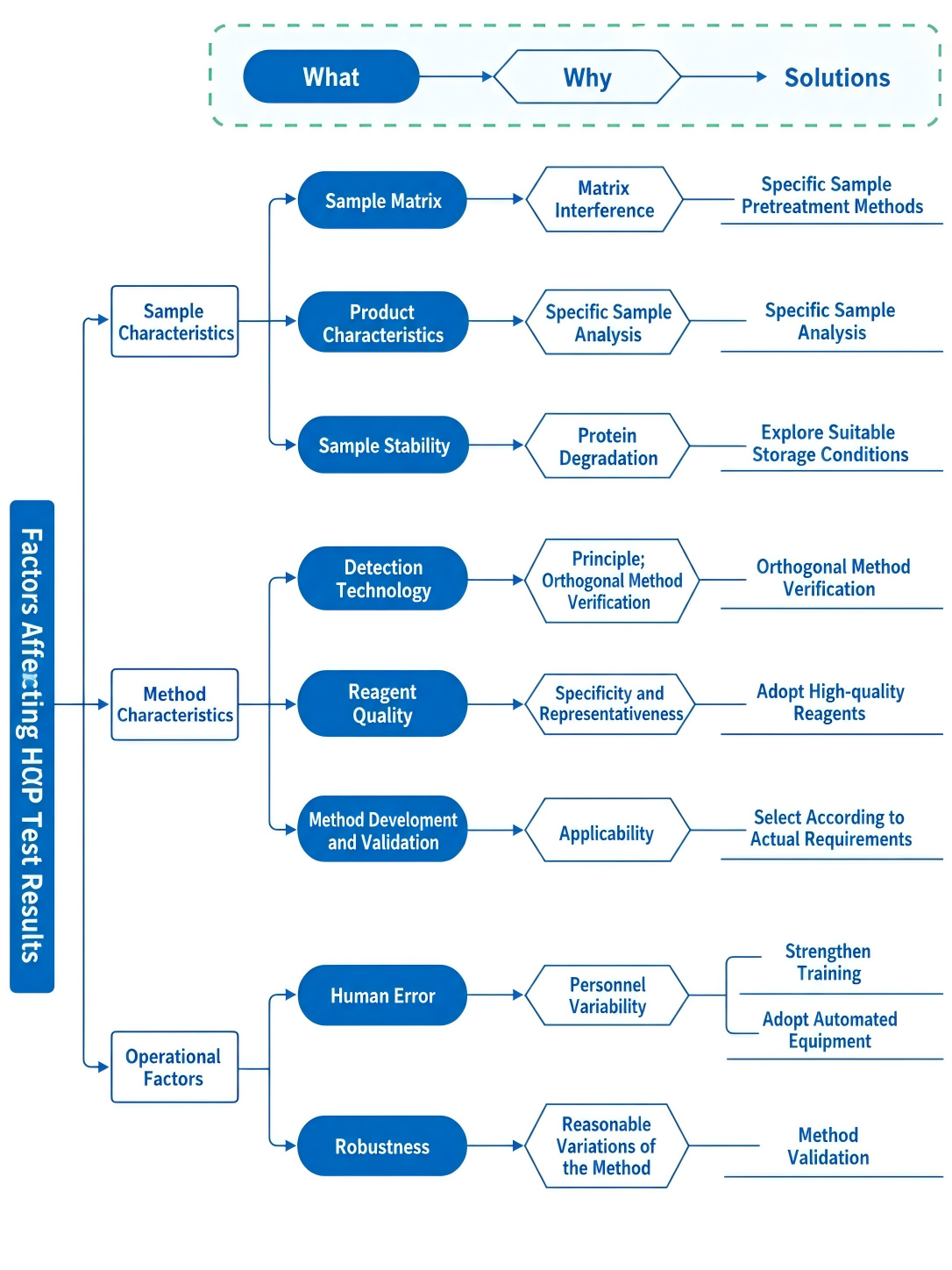
Accurate quantification of HCP residues is not only a mandatory regulatory requirement but also a core safeguard to ensure patient medication safety. However, detection results often fluctuate due to variations in samples, analytical methods, and manual operations; inadequate control at any stage may introduce hidden quality risks. This article systematically analyzes key factors influencing HCP testing results to help QC laboratories avoid common analytical pitfalls.
01 Sample Quality: The Fundamental Basis
1.1 Sample Matrix
HCP testing is implemented across multiple production stages of biopharmaceuticals, including harvest, purification, and drug substance preparation. Detection performance varies drastically between different sample matrices. For example, adjuvants interfere with HCP quantification in adjuvanted vaccine drug products, so HCP testing is generally performed at the drug substance stage prior to the adsorption process.
1.2 Sample Handling and Storage
Sample collection, pretreatment, and storage conditions exert a critical impact on testing accuracy. Improper handling may lead to protein degradation or denaturation, skewing final results. When historical batch samples are used as internal quality control materials, storage conditions and shelf life shall be defined based on corresponding stability data to guarantee the accuracy and robustness of analytical methods.
02 Method Selection: The Core Determinant
2.1 Principles of Analytical Technologies
Enzyme-Linked Immunosorbent Assay (ELISA) and Liquid Chromatography-Mass Spectrometry (LC-MS) are the two mainstream technologies for HCP testing. Literature data indicates ELISA remains the primary technique for total HCP quantitation, while LC-MS serves as a complementary critical tool for identification and targeted quantitation of high-risk individual HCPs.
2.2 Quality of Reagents and Consumables
The quality of testing reagents and lab consumables directly governs result reliability. Substandard reagents may cause false positive or false negative readings: insufficient antibody specificity and affinity lead to cross-reactivity in ELISA; low antigen representativeness or poor antibody coverage results in undetected HCP species; weak anti-interference capacity of sample diluents impairs testing precision.
Case studies demonstrate that switching from commercial off-the-shelf kits to custom-developed methods significantly improves antigen representativeness and antibody coverage, leading to elevated measured HCP values.
2.3 Analytical Method Validation
Dilution linearity testing is conducted to determine the Minimum Required Dilution (MRD) for test samples. Two mainstream calculation approaches are widely adopted in the biopharma industry; laboratories shall select the appropriate calculation strategy based on sample matrix characteristics and regulatory submission requirements.
03 Standardized Operations: The Reliability Guarantee
3.1 Operator Standardization
Analysts’ professional proficiency and practical experience substantially affect testing accuracy. Skilled laboratory personnel can execute sample preparation, reagent formulation, and instrument operation precisely to minimize human-induced errors.
In addition, during analytical method development and routine application, the method’s robustness (acceptable operational variation ranges) shall be fully characterized with dedicated quality control measures embedded into workflows to mitigate human bias.
3.2 Standardization of Operating Workflows
Strict adherence to Standard Operating Procedures (SOPs) is mandatory to ensure consistent and reproducible testing results. Non-compliant operational steps deteriorate assay repeatability and amplify measurement deviation. Automated end-to-end HCP ELISA platforms are commercially available, which fully automate sample preparation, incubation, plate washing, and data acquisition. Integrated with Laboratory Information Management Systems (LIMS), these systems enable one-click sample testing to reduce workflow-associated analytical bias.
Summary
Factors interfering with HCP residue detection results span the entire analytical workflow, where every procedural link may alter final quantitation values.
HZSKBIO® has established a comprehensive HCP analytical technology platform covering commercial ready-to-use kits, custom platform kit development, antibody coverage verification, targeted LC-MS workflows, full-spectrum method validation, routine sample testing, and fully automated ELISA systems. These technologies support control of critical quality attributes (CQAs) for biopharmaceutical safety and quality, delivering robust protection for patients and driving sustainable development of the biopharmaceutical industry.
References
[1] Tuameh, A., Harding, S. E., & Darton, N. J. (2023). Methods for addressing host cell protein impurities in biopharmaceutical product development. Biotechnology Journal, 18, e2200115.
[2] Bracewell, D.G., Francis, R. & Smales, C.M. (2015). The future of host cell protein (HCP) identification during process development and manufacturing linked to a risk-based management for their control. Biotechnology and Bioengineering, 112: 1727–1737.
[3] Li M, Chang WH. Discussion on General Principles for Research and Establishment of Quality Standards for Biological Products. Chinese Journal of New Drugs, 2017, 26(16): 1887–1893.
[4] Jones, M., Palackal, N., Wang F, et al. (2021). “High-risk” host cell proteins (HCPs): A multicompany collaborative view. Biotechnology and Bioengineering, 118, 2870–2885. [5] United States Pharmacopeia (2024). General Chapter <1132> Residual Host Cell Protein Measurement in Biopharmaceuticals. USP-NF. Rockville, MD: United States Pharmacopeia.
[6] United States Pharmacopeia (2025). General Chapter <1132.1> Residual Host Cell Protein Measurement in Biopharmaceuticals by Liquid Chromatography-Mass Spectrometry. Rockville, MD: United States Pharmacopeia.
[7] Li YJ, Kou YZ, Wei KK, et al. Review on Regulatory Considerations and Case Studies of Analytical Method Changes in the Lifecycle Management of Biological Products. Chinese Journal of New Drugs, 2024, 33(11): 1102–1108.
[8] https://www.cygnustechnologies.com/resources/guidelines/
[9] https://www.shenkebio.com/product/2254.cshtml