Products
Host Cell Residue Detection
Process Impurity Assay
Advnetitious Agent/Microorganism Testing
Pyrogen / Endotoxin Detection
Genetic Stability
Cell Line Characterization
Viral Titer Assay
Detection Equipment
Biochemical Reagents

Recently, the research paper titled Optimization and Validation of Multiplex PCR Method for Cell Species Identification was published in Issue 2, 2026 of the Chinese Journal of Biologicals. The research carried out systematic re-optimization and large-scale verification of the original multiplex PCR method for cell species identification, and successfully established a rapid, sensitive and highly robust standardized detection method, providing solid technical support for the newly added General Principle 3430 in the 2025 Edition of the Chinese Pharmacopoeia.
Targeting four species including pig, Chinese hamster, African green monkey and rat, this study optimized key parameters one by one, such as primer sequences, nucleic acid extraction methods, the ratio of primers to reference cell mixed genomic DNA, PCR amplification procedures and the dosage of DNA templates. The optimized method features standardized operating procedures without complicated operations, enabling multi-species detection in a single-tube single reaction. It completely solves the problems of non-specific amplification and band loss of the original method in cross-laboratory application, with greatly improved durability.
After rigorous multiple verification on the sensitivity, limit of detection for cross-contamination and inter-laboratory re-verification of the optimized method, it delivers outstanding detection performance. It can be successfully applied to cell identification and detection of 10 species (pig, human, cat, Chinese hamster, rhesus monkey, African green monkey, rat, dog, mouse and cattle). The detection sensitivity reaches 50 ~ 5,000 cells, and it also has high sensitivity in cross-contamination detection, being able to detect cell contamination at a ratio of 1:100 ~ 1:10,000. Blind sample verification conducted in 4 different laboratories achieved a 100% success rate. The method can accurately identify cells of a single species and precisely distinguish the dominant cell species and contaminating species in cross-contaminated samples.
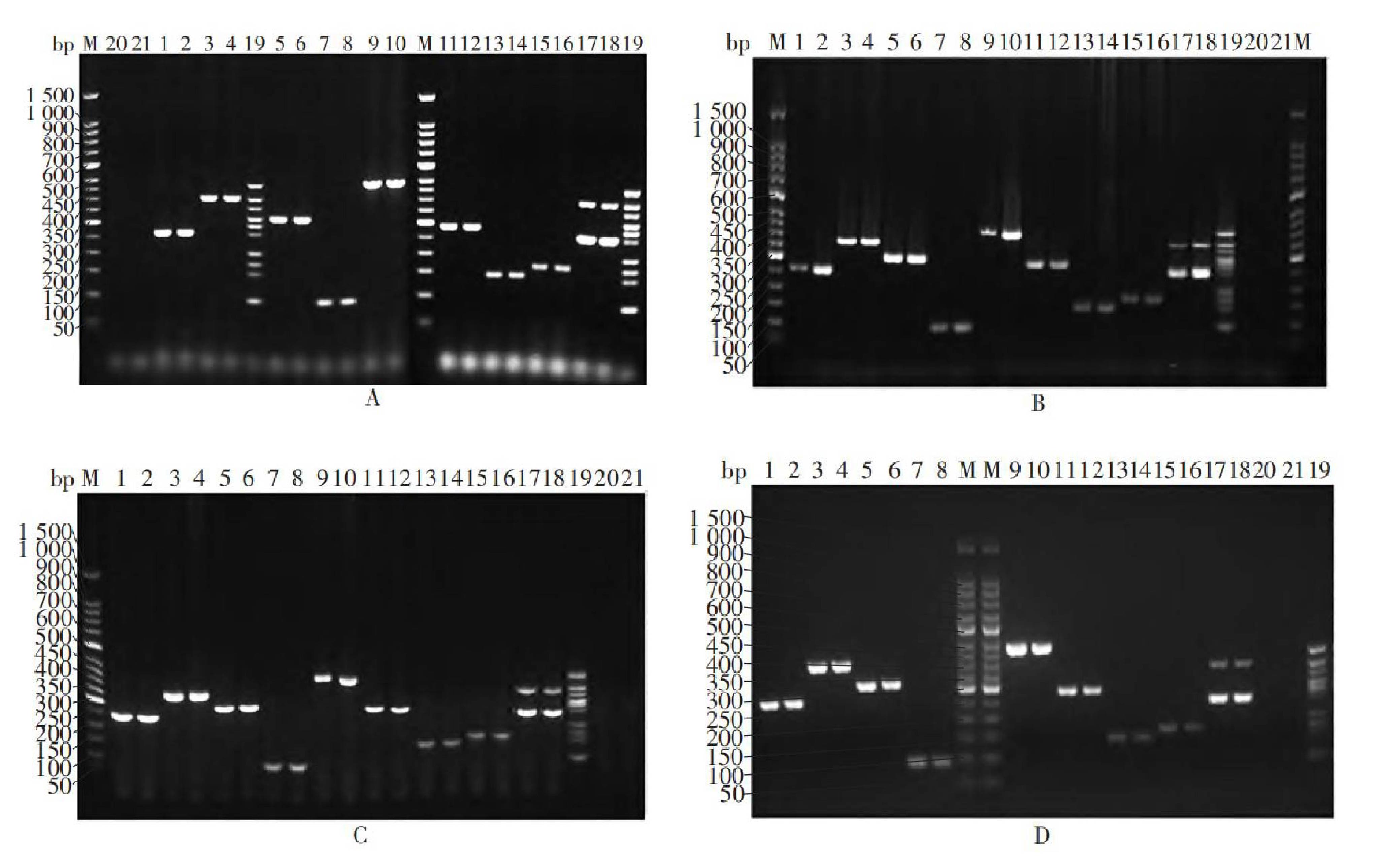
A~D: Four re-verification laboratories respectively
(1,2:S1; 3,4:S2; 5,6:S3; 7,8:S4; 9,10:S5; 11,12:S6; 13,14:S7; 15,16:S8; 17,18:S9; 19: Mixed genomic DNA of 10 species of cells; 20: NTC; 21: NCS; M: 50 bp DNA ladder)
Figure 1: Results of Re-verification
In the fields of biopharmaceuticals and cell therapy, cells serve as the core "seeds" for R&D and production. Nevertheless, cell misidentification and cross-contamination have long been an elusive problem plaguing the industry, which may lead to distorted experimental data, unstable production processes, and even serious product safety risks. Traditional identification methods such as the isoenzyme method have low sensitivity, and chromosome karyotype analysis involves cumbersome operations, which can hardly meet the urgent demand of modern industry for high-throughput, standardized and high-sensitivity quality control.
With the comprehensive advantages of strong specificity, high sensitivity, simple operation and good cross-laboratory applicability, the method established in this study can be applied to cell species identification and cross-contamination detection in all links of biopharmaceutical R&D, production and verification. It provides a standardized technical means for the quality control of production-grade cells and verification-grade cells. Moreover, this method has been included in Chapter 3430 of the 2025 Edition of the Chinese Pharmacopoeia of the People's Republic of China. This marks that the method has evolved from an optimized laboratory technology into an official statutory detection standard at the national level, offering a unified and authoritative technical basis for cell quality control in the entire biopharmaceutical industry.
References
[1] Wu Xueling, Zhang Qimeng, Na Tao, et al. Optimization and Validation of Multiplex PCR Method for Cell Species Identification[J]. Chinese Journal of Biologicals, 2026, 39(02):180-188.
Product Recommendation: Cell Species Identification Detection Kit (Multiplex PCR Method)
Product Features
| High Specificity | Clear and single PCR amplicons. |
| Simple Operation | The kit is equipped with extraction buffer. Cellular DNA can be directly used for PCR amplification after extraction, eliminating complex DNA extraction and purification procedures. |
| High Detection Sensitivity | The limit of cross-contamination detection is as low as 1% or less, and the required cell quantity can be as low as 5×10⁵ cells. |
| High Detection Efficiency | Adopts a 10-plex reaction system in a single well to improve detection efficiency. |
| Authentic and Objective | Potential contamination is reflected in cell quantity unit. |
| Definitive Results | Results are determined according to the number and size of amplified bands, with clear and intuitive judgment criteria. |
| Independent R&D and Stable Supply | All components are independently developed, ensuring stable product supply and consistent batch quality. |