Products
Host Cell Residue Detection
Process Impurity Assay
Advnetitious Agent/Microorganism Testing
Pyrogen / Endotoxin Detection
Genetic Stability
Cell Line Characterization
Viral Titer Assay
Detection Equipment
Biochemical Reagents

The European Pharmacopoeia (EP) 11.8 has added the general chapter 5.1.13 Pyrogenicity, which officially replaces the long-standing Rabbit Pyrogen Test (RPT) with the Monocyte Activation Test (MAT) and explicitly requires enterprises to prioritize MAT for product release testing. This transformation marks the full transition of pyrogen testing from animal tests to in vitro methods in the European Pharmacopoeia. It not only complies with the globally promoted animal welfare and the 3Rs Principle but also aligns with the development trend of New Approach Methodology (NAM) in drug development.
01 Global Regulatory Synergy: MAT from "Optional" to "Mandatory"
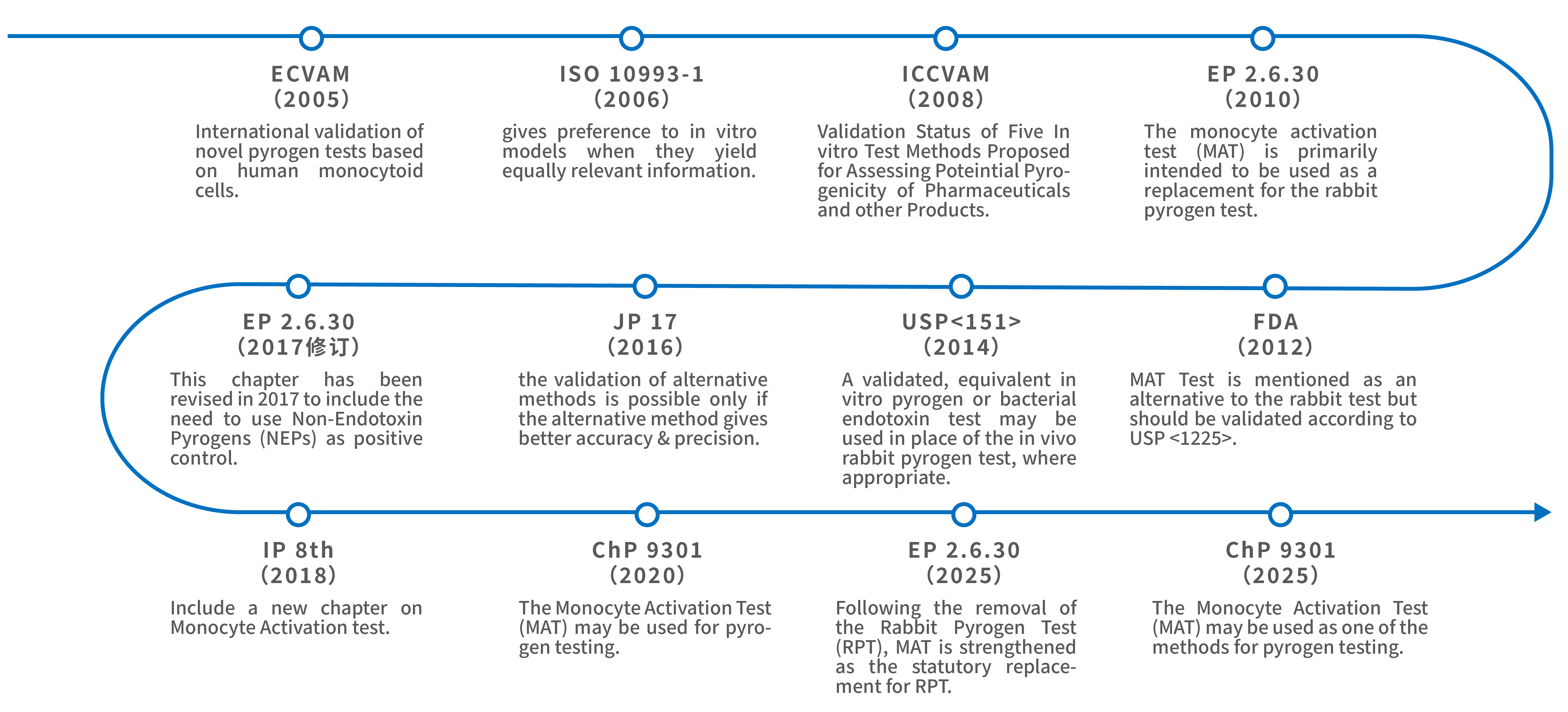
Since being included in the European Pharmacopoeia as an alternative method (EP 2.6.30) in 2010, MAT has gradually become a recognized method for evaluating various pyrogens. The US FDA, United States Pharmacopeia (USP), Russian and Eurasian Pharmacopoeias, etc., have all acknowledged MAT as a pharmacopoeial or alternative method. The Chinese Pharmacopoeia (ChP) listed it as a supplementary method in the 2020 edition and further clarified relevant requirements in the 2025 edition, reflecting synergy with international standards.
This regulatory update means that enterprises manufacturing injectables, biological products, and medical devices marketed or sold in the EU must:
Method Transformation: Establish and validate MAT testing capabilities as soon as possible, or entrust qualified institutions to conduct the test;
Document Update: Revise quality control methods and relevant Standard Operating Procedures (SOPs) in registration dossiers;
Compliant Filing: Submit corresponding variation applications in accordance with the guide.
In the long run, this reform is part of Europe's overall regulatory strategy to reduce animal testing, indicating that in vitro testing methods will become the mainstream in the future.
02 Core Updates of MAT in EP 11.8
EP 11.8 has made detailed revisions to the standardization, quality control, and result acceptance criteria of MAT, mainly covering the following points:
Clear Cell Line Requirements: Certified monocyte cell lines are recommended, which feature standardization, large-scale production, and high stability, and can detect both endotoxins and Non-Endotoxin Pyrogens (NEP).
Refined NEP Controls: Enhance the multi-dimensional interpretation ability of non-endotoxin pyrogen test results.
Optimized Result Interpretation: More stringent acceptance criteria for gradient dilution results to improve testing reliability.
Flexible Standard Curves: Different types of standard curves are allowed, with clear acceptance criteria defined.
Comparison Items | EP11.0-2.6.30 | EP11.8-2.6.30 | 2025 Edition ChP-9301 |
Testing Method | Quantitative & Semi-quantitative & Reference Batch Comparison | Semi-quantitative & Reference Batch Comparison | Quantitative |
Monocyte Cell Line | Suitable for bacterial endotoxin testing, but limited for non-endotoxin pyrogen testing | Capable of detecting both bacterial endotoxins and non-endotoxin pro-inflammatory or pyrogenic contaminants | Not specified |
Limit of Detection (LOD)/Test Sensitivity | Endotoxin concentration corresponding to the cut-off value | The lowest endotoxin reference standard concentration with a response value exceeding the cut-off value on the standard curve | The lowest endotoxin reference standard concentration with a response value exceeding the cut-off value on the standard curve |
Maximum Valid Dilution (MVD) | CLC*c/LOD | CLC*c/Test Sensitivity | CLC*c/LOD |
Standard Curve: Blank OD Value | <0.1 | OD value as low as possible | Not specified |
Standard Curve: Acceptance Criterion | Statistical significance of regression (p < 0.01) | Deleted | Statistical significance of regression (p < 0.01) |
Standard Curve: R2 | Not specified | R2>0.975 | r≥0.90 |
Standard Curve: Number of Concentrations for Regression Analysis | At least 4 concentrations | At least 4 concentrations for linear fitting At least 5 concentrations for four-parameter fitting At least 6 concentrations for five-parameter fitting | At least 4 concentrations |
Spiked NEP Recovery Rate | Not specified | Valid test: 50% < Recovery rate < 200% Invalid test: Recovery rate < 50% Synergistic effect: Recovery rate > 50% | Not specified |
Sample Dilution Factor | 2-fold dilution starting from the determined minimum dilution (not exceeding MVD) | Geometric dilution starting from the determined minimum dilution (not exceeding MVD) | 2-fold dilution starting from the determined minimum dilution (not exceeding MVD) |
Result Judgment - Spiked Recovery Rate | Must meet 50%-200% for 3 consecutive dilution gradients | At least one dilution gradient meets 50%-200% recovery rate, and the test result can be judged valid | |
Result Judgment - CLC | Pyrogen test values of 3 consecutive dilution gradients do not exceed the CLC of the sample | ||
For more detailed regulatory interpretation materials, please contact us to obtain a special PPT.
03 Key Steps for Efficient MAT Validation
As MAT is a pharmacopoeial method included in the European Pharmacopoeia (EP), enterprises are not required to conduct full method validation when using it, and only need to carry out sample suitability validation, which mainly covers the following:
Qualified endotoxin standard curve;
Test solution does not affect IL-6 expression;
No interference of ELISA in IL-6 quantification;
Effective detection of non-endotoxin pyrogens.
Notably, the selected MAT kit supplier must have completed comprehensive performance validation in compliance with ICH Q2(R2), including linearity, range, limit of detection, precision, specificity, and other indicators.
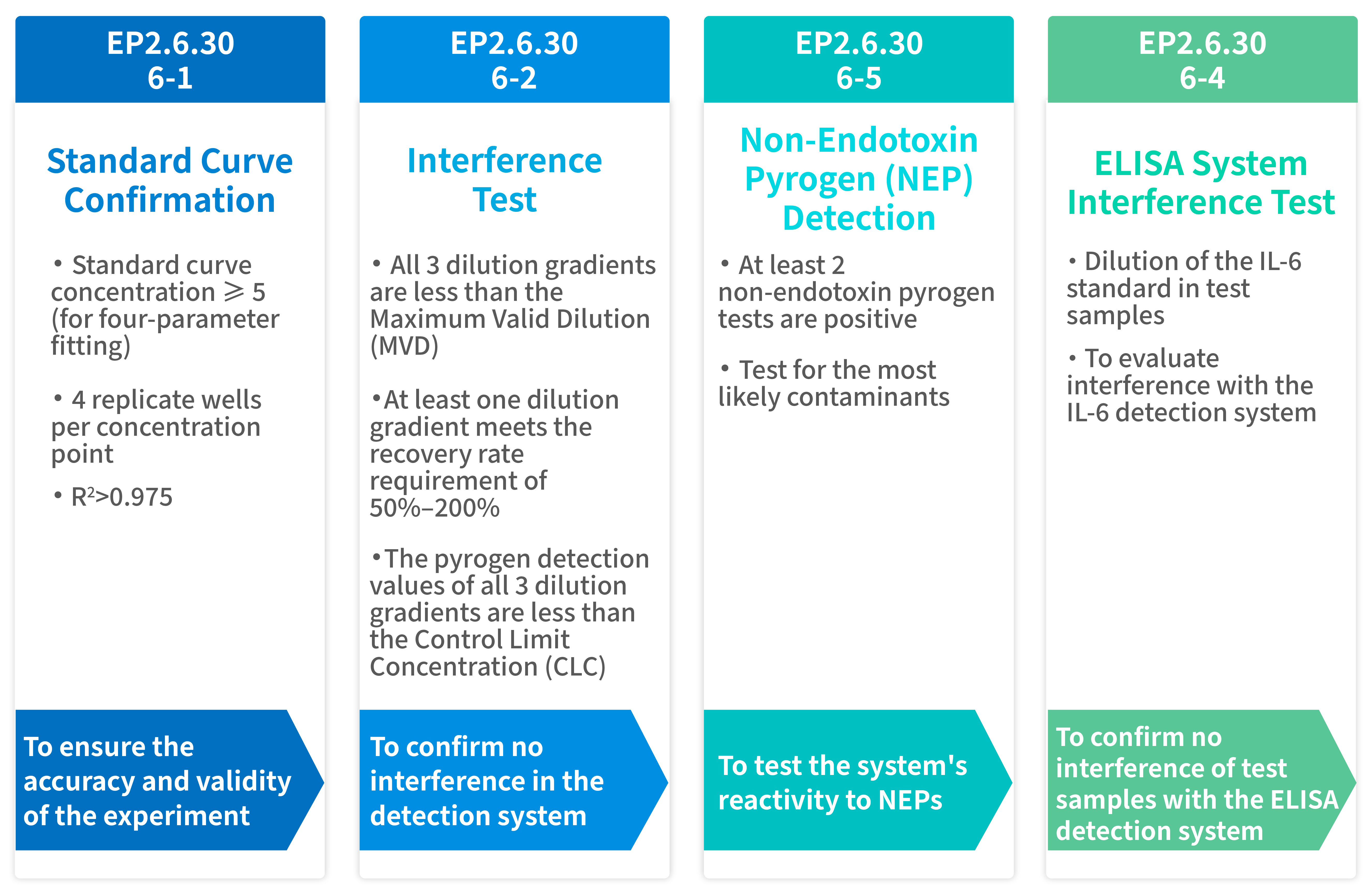
Adopting MAT under the EP framework allows enterprises to significantly reduce upfront validation investment, focus resources on product-specific validation, and achieve a balance of science, compliance, and efficiency.
04 Enterprise Response Guide: Transition from RPT to MAT
The change in testing method is mandatory. If the existing marketing authorization documents still include the rabbit pyrogen test, enterprises should proactively initiate a variation to delete the test and assess whether an alternative method needs to be introduced.
The European Medicines Agency (EMA) recommends in relevant Q&As:
If the submission already includes an appropriate method and is approved, a Type IB Variation can be filed to delete RPT, accompanied by a risk assessment.
If an alternative method is adopted, classification is based on the method type: pharmacopoeial bacterial endotoxin test is Type IB Variation; pharmacopoeial MAT or non-pharmacopoeial in vitro methods are Type II Variations.
05 About PyroSup™ Pyrogen Detection Kit (MAT Method) by Huzhou Shenke Biotechnology Co., Ltd.
Huzhou Shenke Biotechnology Co., Ltd. (abbreviated as HZSKBIO®) has launched the PyroSup™ Pyrogen Detection Kit (MAT Method). The kit has completed comprehensive performance validation in conjunction with authoritative institutions, complying with both EP 11.8 (2.6.30) and USP <1225> requirements, helping enterprises meet EU and US marketing submission needs.
Product Features:
Compliant Cell Source: Authorized by ATCC with clear traceability, worry-free for regulatory submissions;
Regulatory Recognized: Systematically validated with quality and performance superior to similar products;
Wide Applicability: Covers antibodies, vaccines, blood products, traditional Chinese medicine injections, medical devices, chemical drugs, raw and auxiliary materials, etc.;
Proven Cases: Partner of the first enterprise in China to complete the replacement of rabbit pyrogen testing in compliance with EU EP requirements.