Products
Host Cell Residue Detection
Process Impurity Assay
Advnetitious Agent/Microorganism Testing
Pyrogen / Endotoxin Detection
Genetic Stability
Cell Line Characterization
Viral Titer Assay
Detection Equipment
Biochemical Reagents

Against the backdrop of increasingly stringent global pharmaceutical regulations, the European Pharmacopoeia (EP) has continuously updated pyrogen testing requirements for antibiotics. Pyrogen testing for many antibiotic varieties has been shifted from the traditional Rabbit Pyrogen Test (RPT) to the Bacterial Endotoxin Test (BET). Nevertheless, relying solely on BET cannot fully mitigate pyrogen risks. Non-Endotoxin Pyrogens (NEPs), the "invisible hazard", have become a core compliance challenge for regulatory submissions, which is also a major reason why the Monocyte-Activation Test (MAT) has gained widespread attention.
01 Regulatory Timeline: Phase-out of RPT and Rise of MAT
Effective July 1, 2025: EP Supplement 11.8 officially removed the Rabbit Pyrogen Test (RPT), and MAT became the only recommended alternative method[1].
August 2025: Release of EP 12.0 further strengthened relevant guidelines:
• EP 5.1.13 (Pyrogenicity) clearly stipulates that if BET is adopted as the sole testing method, a detailed risk assessment report excluding the presence of NEPs in the product must be provided.
• EP 2.6.30 officially designated the Monocyte-Activation Test (MAT) as a statutory method capable of detecting all types of pyrogens, including endotoxins and various NEPs.
Starting from 2026: The European Directorate for the Quality of Medicines & HealthCare (EDQM) has listed "establishment and implementation of effective NEP control strategies" as a high-frequency inspection item during on-site audits.
For enterprises exporting antibiotics overseas, NEPs have evolved from a technical concept into an urgent compliance requirement.
02 Overview of the Evolution of Pyrogen Control for Antibiotics
RPT was the mainstream pyrogen testing method for antibiotics in EP Edition 3 (1997). Following the adoption of the European Convention for the Protection of Animals in 1986, the European Pharmacopoeia Commission accelerated the application of in vitro alternative testing methods in response to the 3Rs principle (Reduction, Refinement, Replacement of animal testing).
Fermentation Products | Semi-synthetic Products Derived from Fermentation Products | |
Amphotericin B | Amoxicillin Na | Netilmicin sulphate |
In EP 7.0, RPT was replaced by BET for pyrogen testing of 49 fermented or semi-synthetic antibiotics. However, the transition did not cover all antibiotic varieties, and certain antibiotics still retained RPT in EP 11.0[3], mainly due to insufficient data to prove that RPT could be replaced by BET.
List of Antibiotics Where RPT Has Not Been Replaced by BET
Fermentation Products | Semi-synthetic Products Derived from Fermentation Products |
Semi-synthetic Products | Amikacin、Chloramphenicol sodium succinate、Colistimethate sodium、Dicloxacillin sodium、Flucloxacillin sodium |
Fermentation Products | Kanamycin acid sulfate、Kanamycin monosulfate)、Polymyxin B sulfate |
Since EP has officially abolished RPT and defined MAT as the preferred alternative method, two key questions arise: How to select suitable pyrogen testing methods for varieties that have not completed the RPT replacement? Have the 49 antibiotics that adopted BET fully eliminated pyrogen-related risks?
General Chapter EP 5.1.13 (Pyrogenicity) provides the answers:
BET is only applicable when the presence of non-endotoxin pyrogenic substances is ruled out.
If BET is used as the sole method to test product pyrogenicity, risk assessment for potential NEPs is mandatory.
MAT shall be adopted if NEPs cannot be excluded.
For approved manufacturing processes, potential NEP risks are recommended to be assessed. NEP risk assessment is also required whenever process changes occur, and the assessment report shall be submitted together with the process variation application.
03 Compliance Risks for Antibiotic Registration: High Incidence of NEP Issues
The complex production processes of antibiotics are major potential sources of NEPs. NEPs may be introduced in every critical step, ranging from raw materials and metabolites in upstream fermentation to purification and equipment cleaning in downstream procedures. A comprehensive prospective risk assessment across the entire production chain is required to build a full-coverage NEP prevention and control system.
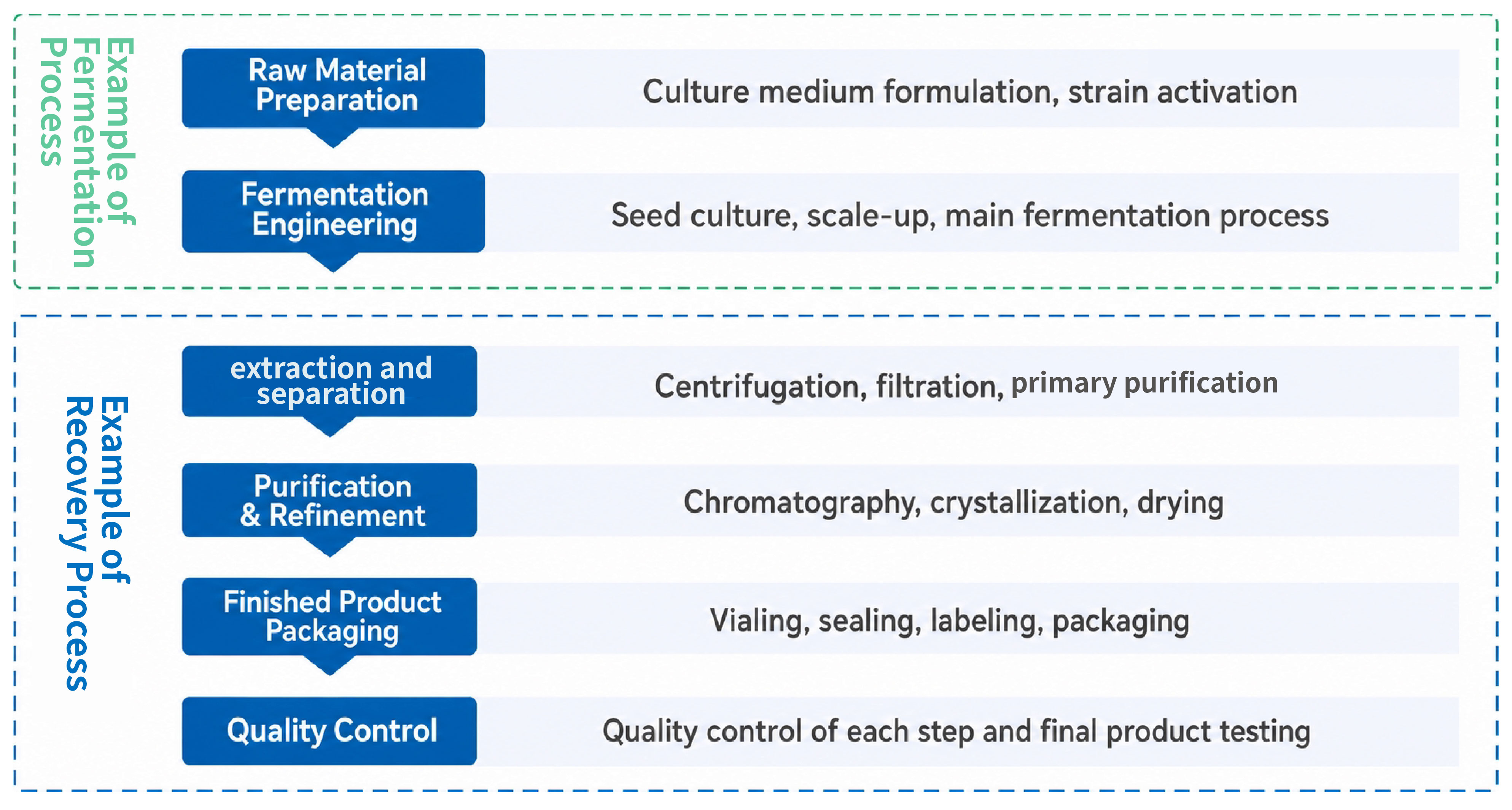
Antibiotic Fermentation and Recovery Process[4]
3.1 Risk Assessment Content: Likelihood of Non-Endotoxin Pyrogen (NEP) Presence
Characteristics of production strains: Classify strains as Gram-positive (G+) or Gram-negative (G-), assess potential pyrogenic components such as Lipoteichoic Acid (LTA) and peptidoglycans, as well as expression levels of specific proteins (exotoxins and other proteins).
Residues from fermentation processes: Remnants of Gram-positive bacteria (HKSA), LTA, peptidoglycans, zymosan and other substances are typical NEPs. These impurities can work synergistically with LPS to increase cytokine levels and trigger aggravated pyrogenic reactions in clinical use.
Composition and source of culture media: Assess risks of animal-derived materials (virus contamination) and plant-derived materials (mycotoxin contamination or synthetic production routes).
Bioburden of raw materials.
Potential cross-contamination in production and environmental monitoring results.
NEP removal capacity of downstream processes:
•Organic solvent extraction: Solvents dissolve target compounds while leaving water-soluble pyrogens undissolved.
•Filtration: Removes high-molecular-weight substances such as proteins, DNA and RNA.
•pH adjustment via strong acid or alkali: Destroys certain pyrogenic substances (on the premise that target compounds remain stable).
3.2 Risk Assessment Methods[1]
EP 5.1.13 (Pyrogenicity) requires that for pharmaceuticals with unexcluded NEP risks, cross-validation with MAT using 3 identical batches shall be conducted alongside BET verification. Repeated cross-validation on 3 batches is required if critical process parameters are modified.
Verification requirements for NEP tests specified in EP Supplement 11.8, Clause 2.6.30-6.5:
Pre-tests shall adopt no less than 2 types of NEP ligands (e.g., peptidoglycan, lipoteichoic acid, synthetic bacterial lipoprotein, flagellin) to verify the testing system, among which at least one ligand shall be spiked into the test formulation.
Priority shall be given to historical positive samples confirmed to be contaminated with NEPs. If such samples are unavailable, NEPs likely introduced during production shall be used for system verification.
04 Eliminate Compliance Blind Spots | Huzhou Shenke Biotechnology Co., Ltd. (HZSKBIOⓇ) Provides Full-cycle Support for Pharmaceutical Overseas Expansion
Leveraging self-developed reagents and extensive experience in matrix analysis, Huzhou Shenke Biotechnology Co., Ltd. (HZSKBIOⓇ) delivers customized solutions tailored to sample characteristics and addresses supplementary data requests from European and American regulatory authorities. The company supports enterprises in technical upgrades (e.g., switching from RPT to MAT for Polymyxin B/E), NEP risk assessment (e.g., Epirubicin Hydrochloride, recombinant antibodies), and provides complete verification solutions covering pre-treatment method development to regulatory submission support for various samples. It fundamentally resolves compliance uncertainties and accelerates the overseas launch of pharmaceutical products.
Applicable Samples for PyroSup™ MAT Pyrogen Test Kits
| Category | Product Names | Test Kit | Pre-treatment Kit | ||||
| Antibiotics | Cefotaxime Sodium | Tedizolid Phosphate | Famotidine | Palonosetron Hydrochloride | Azlocillin Sodium | MAT Test Kit | / |
| Cefuroxime Sodium | Amikacin Sulphate | ||||||
| Small-molecule Drugs | Polymyxin B & E | MAT Test Kit | Pre-treatment Reagent A | ||||
| Epirubicin Hydrochloride | MAT Test Kit | Pre-treatment Reagent B | |||||
| Monoclonal Antibodies | Rituximab | Sintilimab | Adalimumab | Nimotuzumab | Ranibizumab | MAT Test Kit | / |
Etanercept | Roflumilast | Bevacizumab | Evolocumab | Alirocumab | |||
Vaccines | Rabies Vaccine for Human Use | Freeze-dried Hepatitis A Inactivated Vaccine | Measles, Mumps and Rubella Combined Live Attenuated Vaccine, | Quadrivalent Influenza Split Vaccine | Group A & C Meningococcal Vaccine | ||
Influenza Split Vaccine | Varicella Live Attenuated Vaccine | ||||||
Recombinant Proteins | Recombinant Insulin Injection | Teriparatide Injection | Recombinant Human Erythropoietin Injection | Recombinant Human Interferon α-2b Injection | Recombinant IL-11 for Injection | ||
Insulin Glargine | |||||||
Blood Products | Prothrombin Complex Concentrate | Intravenous Immunoglobulin | Coagulation Factor Ⅷ | Human Albumin | |||
Biochemical Drugs | Urokinase | Succinylated Gelatin | Collagenase | Ademetionine 1,4-Butanedisulfonate | Glutathione, Ziprasidone Mesylate | ||
| Ziprasidone Mesylate | Indocyanine Green | Mannan Peptide | Nicotinamide | Reduced Glutathione | |||
Adrenaline Hydrochloride | |||||||
Injections | Shenmai Injection | Xiangdan Injection | Normal Saline | ||||
Raw & Auxiliary Materials | BSA | Fetal Bovine Serum | Cefotaxime Sodium | Troxerutin | |||
Advantages of PyroSup™ MAT Pyrogen Test Kits
1. Compliance foundation for regulatory submission: Cells have clear sources and commercial authorization, eliminating compliance risks during registration.
2. Regulatory recognition and stable performance: Fully validated with authoritative institutions, and tested by clients and regulatory bodies; superior quality and performance compared with peer products.
3. Powerful technical capability: The cell line features excellent universal applicability. Combined with targeted pre-treatment protocols, it breaks through limitations of diverse testing scenarios.
4. Proven successful cases: Has supported multiple products to complete marketing authorization applications in the EU and FDA with mature registration experience.
5. Qualification certification: Certified with ISO 13485 quality management system and CNAS laboratory accreditation; rich experience in regulatory submissions across China, the US and Europe.
References
[1] Europaea, P. (2025). 2.6.30. Monocyte-activation test-11.8.
[2] Source: EDQM; Animal Welfare Progress; PA/PH/SG (07) 8
[3] Europaea, P. (2020). 2.6.30. Monocyte-activation test
[4] Dr. Uwe Lipke. Phasing out the rabbit pyrogen test – the view from the perspective of antibiotics. 15 February 2023